
After nearly a decade performing minimally invasive bunion surgery, Dr. Justin Kane shares what he’s learned from thousands of cases—including what patients should know about recovery, candidacy, and long-term results.
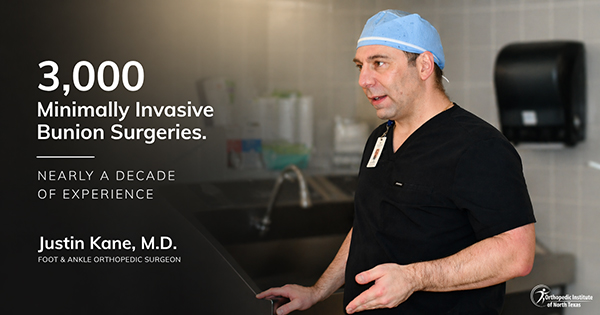
When I performed my first minimally invasive bunion surgery in 2017, almost nobody in the United States was doing it.
It was a lonely road early on. There was no real American playbook, no polished technique guide, and very few surgeons I could turn to for practical answers. What I had were surgical principles, conviction, and a belief that bunion patients deserved something better.
I still remember that first case vividly. I was about three years into practice in Frisco, part of the Dallas-Fort Worth area, where I treat patients from across North Texas. The patient was a young woman in her early 30s who had read about minimally invasive bunion surgery and could not find anyone to do it. She came to me because the procedure was mentioned in my biography. I was very honest with her. I told her that every “patient” I had done it on had done well, but those patients were cadaver legs in labs, not people in real life. I explained that if I felt it needed to be converted to a traditional bunion procedure for her safety or outcome, I would do exactly that. She understood. She trusted me. And I remember praying at the scrub sink for God to guide my hands.
The case went well, although it was stressful. Two weeks later, she came back walking without a limp and had already decided she felt good enough to wear regular sandals. That was my first real moment of clarity. It was the moment I realized this was not just an interesting new technique. It was a meaningful change in what bunion surgery could look like for patients.
After nearly a decade and almost 3,000 minimally invasive bunion cases later, I can say this with confidence: minimally invasive bunion surgery has changed the patient experience for the better. But I can also say something equally important. The procedure itself is only part of the story. The judgment behind it matters just as much.
Why I Started Minimally Invasive Bunion Surgery Early
One of the reasons this procedure matters so much to me is that I did not step into it after it had become standardized, widely taught, and simplified for mass adoption. I came into it when there were very few people doing it in the United States and almost no clear domestic roadmap.
In 2016, I was lecturing in Lisbon, Portugal, and one of the French innovators of the procedure was there. He told me, half joking and half serious, that Americans were missing the boat on how to do bunion surgery. We did a cadaver lab together, and the mechanics made sense. The biologic logic made sense. The patient implications made sense.
But understanding a concept and living it in real surgery are two very different things.
At that time, everything felt missing. There was no real technique guide. There was no broad peer group in the United States to call for practical advice. There was no mature training pathway where you could simply follow a checklist and feel safe. It was more like this: here are your tools, here are your principles, now figure it out.
That is not comfortable. It is not glamorous. It is stressful. But it was also formative. It forced me to rely on first principles: how to correct a bunion, how to respect biology, how to think critically under pressure, and how to put the patient first when the path was not yet paved.
Why Minimally Invasive Bunion Surgery Improves Patient Outcomes
My belief in minimally invasive bunion surgery was never based on novelty. It was based on reality.
Orthopedic surgery has seen this kind of evolution before. We saw it in shoulder surgery with the move toward arthroscopy. The late Henry Mankin, the renowned Harvard tumor surgeon, once said that the miracle of surgery is not that we make people better, but that people get better despite the trauma we put them through. That idea stayed with me.
If we could achieve reproducible, durable bunion correction with less soft-tissue trauma, less perioperative burden, and a smoother recovery, why would we not pursue that? For decades, bunion surgery had a reputation for being painful, disruptive, and prolonged. Patients often feared it as much as they feared the deformity itself. The question I kept coming back to was simple: could we do better?
I believed the answer was yes.
I also believed bunion patients deserved more than old horror stories. They deserved a procedure that addressed their pain and deformity without making recovery feel like a mountain they had to climb. That patient-centered goal is what drew me in early, and it is still what motivates me now.
The Learning Curve of Minimally Invasive Bunion Surgery
The truth is that every single one of my early cases was stressful.
When you are using a burr and working off fluoroscopy, minutes can feel like hours. There is very little margin for error. Early on, even the operating room staff had never really seen anything like it. They were looking at me like I was practicing witchcraft. That is funny now, but at the time it captured the reality of how foreign this looked compared with conventional bunion surgery.
This is one of the things patients and even some surgeons may not fully appreciate: small incisions do not make a procedure simple. If anything, they demand more discipline. Perfect fluoroscopy is not a suggestion. It is dogma. Every step has to be deliberate. There is no “good enough.” If something needs to be corrected, translated, or redone, you do it. Form follows function, and a bunion correction that is not executed precisely is simply a poorly performed procedure.
For me, it took about 25 cases to start feeling comfortable. The next 25 taught me a different lesson: how much I still did not know. Then another 50 cases brought the deeper understanding that eventually makes a procedure feel coherent rather than chaotic.
The best analogy I know is what athletes describe when they move from one level to the next. At first the game feels too fast. Everything is chaotic. Then, over time, the game slows down. You begin to see what matters sooner. You anticipate problems earlier. You understand timing better. That is what happened here. The procedure did not become easier because it was simple. It became more reproducible because experience sharpened judgment.
How My Surgical Technique and Recovery Protocols Evolved
One of the biggest lessons of nearly a decade in this space is that mastery usually looks simpler in the end, not more complicated.
Early on, I wrestled with questions that sound small but matter enormously in practice. One screw or two? How quickly should patients advance activity when they feel so much better than traditional bunion patients often did? When do you let people return to normal life if they are walking well, feeling surprisingly comfortable, and there are no established guidelines to follow?
That is where lived experience changed everything.
Over time, my technique became clearer and more standardized. I transitioned fully to single-screw fixation. I refined how I achieve osteotomy translation. I evolved my closure technique. Early on, I thought minimally invasive surgery should mean no sutures at all. I no longer believe that. Now I use four total stitches for the procedure because it improves soft-tissue healing and helps patients recover more efficiently.
My postoperative protocol also matured significantly. Today, most patients transition into shoes with a carbon fiber insert at two weeks and stay with that support until twelve weeks. I avoid rigorous impact exercise until twelve weeks. And just as importantly, I spend a great deal of time helping patients understand the difference between how they feel and how their body is actually healing.
That distinction is critical.
One of the realities of modern minimally invasive bunion surgery is that many patients feel so good so early that they are tempted to outrun biology. As a surgeon, part of my job is slowing people down when they feel ahead of schedule. A patient’s symptoms can improve faster than bone and soft tissue fully heal. Understanding that mismatch, and helping patients navigate it, has become one of the most important parts of what I do.
What Patients Should Know About Bunions and Bunion Surgery
There are a few things I wish every patient understood.
First, bunions do not get better without surgery. You can often improve symptoms for a period of time without surgery. You can modify shoes. You can adjust activity. You can use padding, orthotics, or anti-inflammatory strategies. But none of those things correct the deformity itself. A bunion does not reverse on its own.
Second, minimally invasive bunion surgery is not your grandmother’s bunion surgery.
That matters because so many patients still carry fear based on stories from decades ago, or from friends and family members who underwent traditional procedures with substantial pain, prolonged immobilization, and a difficult recovery. Modern minimally invasive bunion surgery is different. In experienced hands, patients can bear weight immediately. Early pain is often much less than what people expect. Scarring is minimal. Early postoperative function is better. And catastrophic complications are exceedingly rare.
That does not mean this is “non-invasive.” It is still surgery. There is still healing. There is still recovery. We should never confuse smaller incisions with no recovery at all.
And finally, I tell patients this all the time: we do not do this for cosmesis. We treat painful bunions, not ugly feet. A bunion procedure is about pain, function, alignment, and getting patients back to life. It is not a vanity operation in my practice.
Why Surgeon Experience Matters in Bunion Surgery
I believe minimally invasive bunion surgery will become the gold standard over time. It should increasingly become part of every well-trained foot and ankle surgeon’s armamentarium.
But for now, we are still in the dawn of a new era.
That means surgeon experience matters. The tools matter, but the hands matter just as much, if not more. The mistakes in this procedure are real. The traps are real. Experts can make it look easy, and that can be dangerous, because what looks easy in a master’s hands is often anything but easy in reality.
The biggest mistakes I see are underestimating the learning curve, overpromising results, and confusing a marketing label with real technical proficiency. I see my share of failed minimally invasive bunion cases as second opinions. When adoption becomes casual, patients pay the price.
A cadaver lab can teach mechanics. A course can teach concepts. But high case volume teaches something much more important: when a patient is in trouble. These cases do not always go off course the same way traditional open cases do. Without experience, a situation can deteriorate quickly. An experienced surgeon recognizes warning signs before, during, and after surgery. That recognition is what protects patients.
I often say that I do not treat bunions. I treat people.
That is not a slogan. It is how I think. Patients do not come to me because they want an interesting procedure. They come because they want their life back. They want to know whether they are a good candidate, what they should expect, what recovery will look like, and what happens if the course is not perfectly linear. Experience matters because people deserve more than a surgeon who knows what to do when everything goes right. They deserve a surgeon who knows what to do when it doesn’t.
What nearly 4,000 Bunion Surgeries Have Taught Me
Before I adopted minimally invasive bunion surgery, I had already performed about 1,000 bunion surgeries in more traditional fashion. Since then, I have performed almost 3,000 minimally invasive bunion cases.
That matters because I understand bunion surgery from both worlds. I know what patients used to fear. I know why they feared it. And I know how much the experience can improve when the operation and the recovery are thoughtfully modernized.
I have also had the privilege of teaching this procedure extensively. Over the years, I have trained a few hundred surgeons in numerous settings: one-on-one teaching, proctoring, surgeons visiting my operating room, group education, cadaver labs, national meetings, and international conferences. I currently teach residents as well, talking them through the decision-making and technical details in real time during surgery. I have worked with industry leaders in the field on think tanks, teaching, technique guides, and broader efforts to advance the technology as a whole.
But the reason I mention that is not to build a résumé in public. It is to make one point clear: when you spend years performing, teaching, refining, and troubleshooting a procedure, you begin to understand it in a different way.
You learn not just what works, but why it works.
You learn not just how to correct a bunion, but how to guide a patient through the entire journey.
You learn how to ask the questions the patient has not asked yet. When can I drive? When can I work? When can I travel? When can I exercise? What is normal? What is not? That is often where experience becomes most valuable. It allows me to navigate the process for patients, not just perform the surgery.
Recovery Timeline After Minimally Invasive Bunion Surgery
When I talk to patients about recovery, I tell them there is a predictable parabola to it, but not everyone stands in the same place on that curve.
Some patients need almost no pain medication. Some need more. One example that stands out to me is a surgeon I operated on who was able to go back to work the next day. Another was a patient who stood general admission at a Willie Nelson concert two days later. Those are memorable examples, but they are not promises. They are illustrations of what can happen when the procedure and patient alignment are right.
The broader pattern is more important.
The vast majority of my patients are back in shoes in two weeks. Many return to light exercise around six weeks. Most are back to full activity by twelve weeks. That does not mean the recovery is completely finished at twelve weeks. Like almost any foot surgery, full recovery is more realistically a six- to twelve-month process, especially when it comes to the final resolution of swelling and the occasional soreness after strenuous activity.
One of my favorite patient groups is what I jokingly think of as the patients with fear from the other side. These are people who had traditional bunion surgery on one foot years earlier and delayed the second side for a long time because they were afraid of repeating the experience. When they finally go through modern minimally invasive bunion surgery, many of them cannot believe the difference. Those moments are deeply satisfying because they highlight just how much the patient experience has changed.
Truthfully, before I began performing minimally invasive bunion surgery, I treated bunions because patients were suffering and needed help despite the burden of surgery. Now I genuinely look forward to caring for bunion patients. That is how much this has changed the experience for the people I serve.
Who Is a Good Candidate for Minimally Invasive Bunion Surgery
The best candidates are not defined by marketing language. They are patients whose bunion pain is genuinely affecting their lives.
A great candidate is someone encumbered by bunion pain, someone who wants relief, someone who wants to reduce downtime, and someone who values a dependable recovery process with a markedly higher degree of confidence. These are patients who are ready to move forward, but who understandably do not want to sign up for the kind of prolonged ordeal bunion surgery used to imply.
Patients who are not good candidates include those seeking surgery solely for cosmetic reasons, those with meaningful infection concerns, and those unwilling to follow a thoughtful recovery protocol. In some cases, certain diabetic patients may also require more careful selection depending on the overall risk profile.
The right procedure always starts with the right patient. That principle matters more than any buzzword.
The Future of Minimally Invasive Foot and Ankle Surgery
I believe we are only scratching the surface.
Over the next five to ten years, I expect to see better preoperative templating, better hardware, broader community adoption, and a wider range of foot and ankle procedures performed minimally invasively. And I do not think this stops with bunions or even with forefoot surgery. I expect the continued evolution of minimally invasive approaches across fusions, Charcot work, deformity correction, sports procedures, and beyond.
What excites me most is not the technology by itself. It is the patient.
Foot and ankle surgery can be some of the most inconvenient surgery in orthopedics because mobility is everything. When patients cannot get around, the burden is immediate and debilitating. If we can reduce perioperative risk, reduce surgical trauma, and change the practical burden of recovery, then we can better serve our community. Patients no longer have to wait for the “right time” to be disabled. We can help them sooner. We can address their suffering earlier. We can make treatment more compatible with real life.
My biggest concern is that as adoption grows, quality must grow with it. In any rapidly evolving surgical field, there is always a risk that enthusiasm can outpace education. My view is that expansion is a good thing, but only if it remains grounded in rigorous training, good judgment, and patient-centered standards.
Surgery always has to keep fighting dogma. Dogma gets in the way of scientific advancement. There is still resistance in some circles to the idea that minimally invasive bunion surgery is real, durable, and better for many patients. I do not share that skepticism. I believe this works. I believe it is real. And I believe it represents a better path forward for many of the people who come to see me.
Choosing the Right Bunion Surgeon: What Patients Should Know
If you are considering bunion surgery in DFW, elsewhere in Texas, or even farther away, my advice is simple: do not choose your surgeon based on a buzzword alone.
Choose someone who can tell you whether you are truly a candidate. Choose someone who knows the procedure, the recovery, the potential pitfalls, and the decision-making around complications. Choose someone who can explain not only how the surgery is done, but how your life is likely to look in the days, weeks, and months afterward.
Technique matters. Experience matters. But most of all, judgment matters.
After nearly a decade and almost 3,000 minimally invasive bunion cases, I believe more strongly than ever that this procedure has changed bunion care for the better. It has changed what many patients can expect from surgery. It has changed how quickly many can get back to life. And it has changed how I think about what good bunion care should feel like.
If bunion pain is affecting your daily life, the right next step is not fear. It is a thoughtful evaluation, a clear conversation, and an honest plan built around your goals.
When to See a Specialist
- If pain affects daily life
- If shoes no longer fit comfortably
- If deformity is progressing
- If conservative treatment failed
Schedule a consultation with a foot and ankle specialist at the Orthopedic Institute of North Texas (OINT).

Justin Kane, M.D.
Foot & Ankle Orthopedic Surgeon
Dr. Justin M. Kane is a board-certified, fellowship-trained orthopedic surgeon specializing in foot and ankle surgery at the Orthopedic Institute of North Texas, serving patients across the Dallas–Fort Worth area.
With more than a decade of experience and thousands of procedures performed, Dr. Kane has developed particular expertise in minimally invasive bunion surgery and advanced reconstructive techniques for complex foot and ankle conditions, including deformity, trauma, arthritis, limb salvage and limb lengthening.
He is known for his patient-centered approach, combining surgical precision with individualized treatment planning to help patients preserve motion, restore function, and return to an active lifestyle with confidence.