
Revision and complex reconstruction account for approximately one-third of my practice. I routinely evaluate patients referred by physicians and surgeons throughout Texas, across the United States, and internationally after prior foot or ankle treatment has failed.
It is a story as old as surgery.
A patient has a painful or disabling problem. They are told they need an operation. They put their work, family responsibilities, finances, and life on hold. They undergo the surgery expecting that the pain will improve and that they will eventually return to the activities they have been missing.
Then they do not get better.
Sometimes the pain never improves. Sometimes the patient initially feels better and then gradually deteriorates. Sometimes there is a specific moment—a pop, a fall, a wound, or an unexpected increase in pain—after which everything changes.
I was fortunate to complete both my residency and fellowship training in tertiary referral environments known for treating failed prior interventions. I saw patients who had not walked normally for years. I saw large, physically imposing men reduced to tears. I saw people whose relationships, careers, independence, and sense of identity had been consumed by pain.
There was not one patient who created my interest in revision surgery. It was the cumulative and sobering realization that surgery can leave a person no better—and sometimes worse—than where they started. That can happen after a poorly planned or poorly executed operation, but it can also happen after a technically appropriate surgery performed for reasonable indications.
A failed outcome does not necessarily mean that someone was negligent. It does mean that the patient deserves an honest explanation of what is wrong now and whether there is a reasonable path forward.
From tears of frustration to tears of relief
I recently saw a gentleman 12 weeks after I revised a failed midfoot fusion. His original reconstruction had resulted in both malunion and nonunion. Before he came to see me, he had consulted numerous surgeons and received recommendations that were all over the board. The proposed operations differed. The recovery estimates differed. Even the explanations for why he was still hurting differed.
During one of our first conversations, he cried out of sheer frustration.
At his 12-week visit after revision surgery, he was pain-free and walking in a regular shoe. This time, his tears were different. They were tears of relief—and hope that he could have a pain-free, functional future again.
Not every revision patient will have the same result, and I never use an individual success story to promise someone else a particular outcome. But that experience illustrates why these cases are among the most rewarding operations I perform.
The profound effect of a failed surgery cannot be underestimated. Patients have often placed their lives on hold once already. When the operation does not succeed, the emotional, physical, and financial burden affects not only the patient, but also their spouse, family, friends, coworkers, and everyone helping them through recovery.
A failed surgery is not automatically a "botched" surgery
Patients understandably want to know why the first surgery did not work. Many also arrive angry. I frequently hear some version of:
- "Did my surgeon do something wrong?"
- "Was this botched?"
- "Should I sue?"
Those are emotionally understandable questions, but playing Monday-morning quarterback rarely helps the patient move forward.
A well-executed surgery can fail. A poorly conceived operation can occasionally succeed despite its limitations.
Most unsuccessful outcomes arise from some combination of three broad areas:
- The original diagnosis, planning, mechanics, fixation, or execution
- The patient's biology, medical condition, healing capacity, or ability to complete the recovery
- An adverse outcome despite an otherwise reasonable patient, surgeon, and treatment plan
Very few revision cases I evaluate appear to be the result of a negligent surgeon. When I see something that is genuinely outrageous, I am not going to misrepresent it. Honesty matters. But an unsuccessful surgery and an improperly performed surgery are not synonymous.
My responsibility is to acknowledge the patient's experience without assigning blame before I have the facts. The most useful questions are usually:
What is causing the problem now? Why did the original treatment not produce the expected result? What can we reasonably do next?
Putting the past in the rearview mirror is often healthier emotionally and more productive surgically.
What revision foot and ankle surgery actually means
Revision surgery is difficult to encapsulate because it is not one operation or one treatment algorithm.
Sometimes revision means repeating or repairing a procedure that did not heal correctly.
Sometimes it means pivoting completely and choosing a different treatment than the one attempted previously.
Sometimes it means identifying and treating pathology that was not addressed during the original surgery.
Sometimes it means removing failed implants, restoring lost alignment, correcting a nonunion or malunion, rebuilding deficient bone, or treating a previously unrecognized infection.
And sometimes revision surgery is no longer simply about pain relief. It becomes an effort to save an extremity that may otherwise be heading toward amputation.
Revision is therefore not merely "doing the surgery again." It is a new diagnostic and strategic exercise built around a more difficult question:
What is the real problem now, and what is the best path forward from here?
The first revision visit is a reset
I approach the first revision consultation as a reset.
I was not present for the first round. I do not want to inherit every previous assumption without independently evaluating it. I need to understand the original problem, the intervention that was performed, the recovery that followed, and the symptoms the patient has now.
We start as objectively as possible and try to remove the palpable emotion from the room long enough to assess the current problem.
That evaluation may require:
- A careful physical examination
- New weight-bearing radiographs
- CT or MRI imaging
- Infection-related laboratory studies
- Vascular testing
- Medical or cardiac clearance
- Evaluation of diabetic control
- Review of the previous implants and operative technique
- Other specialized testing based on the patient and pathology
Sometimes advanced testing is essential. Sometimes a good examination and properly obtained plain X-rays explain most of what is happening.
I also want the prior operative reports, relevant clinic notes, and preoperative and postoperative imaging. I want both the actual images and the written radiology reports.
I do not make revision decisions from a radiology report alone. Radiologists and reconstructive surgeons may evaluate the same study through different lenses. The report tells me what the radiologist identified. The images allow me to examine alignment, mechanics, implant behavior, bone healing, residual deformity, and whether the prior reconstruction addressed the underlying pathology.
Persistent pain after foot or ankle surgery
Pain is expected after surgery. It should generally subside with time.
I tell patients that recovery is rarely linear. It behaves more like the stock market. There are good days and bad days, rallies and setbacks, but the overall trajectory should still be upward.
A single difficult day does not necessarily mean something has failed. A meaningful departure from the anticipated recovery deserves further evaluation.
The history often provides important clues:
- "It never felt better."
- "I felt a pop and the pain came back."
- "I was doing well, and then it gradually started getting worse."
- "The deformity seems to be returning."
- "The wound never completely healed."
- "The X-rays supposedly look fine, but I still cannot walk."
A technically successful operation can leave a patient in pain for many reasons. These may include prominent or painful hardware, nonunion, residual deformity, failure to address accompanying pathology, nerve-mediated pain, stiffness, overload of an adjacent joint, or an incorrect initial diagnosis.
One relatively straightforward finding is lucency around hardware after an attempted fusion. That can indicate motion and possible nonunion. Other problems are more subtle. Mild residual deformity may appear unimpressive on one image but create significant mechanical dysfunction when the patient stands and walks.
Research also suggests that diagnosis of nonunion after ankle fusion can sometimes be substantially delayed, reinforcing why persistent symptoms should not be dismissed solely because early radiographs appear reassuring. [1]
A thorough examination and critical radiographic assessment are requisite. It takes experience to distinguish a difficult but normal recovery from an abnormal trajectory.
When severe pain may not be a mechanical failure
Some patients have persistent, disproportionate pain even though the prior operation appears structurally appropriate.
Those cases require caution.
Complex regional pain syndrome, nerve injury, or another pain-amplification process may be contributing to the symptoms. CRPS can occur after trauma or surgery and may include disproportionate pain, sensitivity, swelling, temperature or color changes, and functional impairment. Additional surgery without a clearly correctable structural problem may intensify rather than alleviate those symptoms. [2]
The fact that a patient is hurting does not automatically mean another operation is the answer.
Sometimes responsible revision care means continuing the investigation, coordinating multidisciplinary treatment, or advising against surgery.
Why deformity comes back
Recurrent deformity is one of the most common reasons patients seek a revision opinion.
This may include:
- Recurrent bunion deformity
- Failed hammertoe or forefoot reconstruction
- Recurrent flatfoot
- Residual cavus or cavovarus deformity
- Collapse after midfoot reconstruction
- Malalignment after hindfoot or ankle surgery
There are multiple potential explanations. The original procedure may not have addressed the true instability. The deformity may not have been corrected in all three planes. The fixation may not have been sufficient to hold the correction. The patient's bone or soft tissues may not have supported healing. An adjacent deformity may have continued to drive abnormal forces through the reconstruction.
Foot and ankle deformities are three-dimensional. An operation can look acceptable on one radiographic view and remain mechanically unbalanced in another plane.
The revision plan should not simply repeat the first operation more aggressively. It must identify the mechanical reason the correction failed.
Revision is not only about correcting what came back. It is often about correcting what was missed.
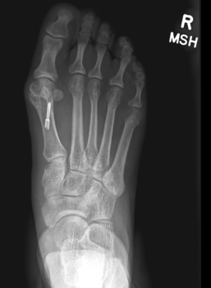
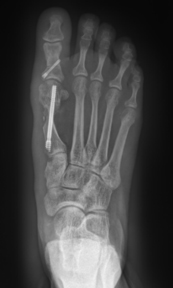
Revision Failed Bunion with Malpositioned Hardware
Recurrent bunion deformity following prior surgery, followed by revision reconstruction addressing residual instability and three-dimensional alignment.
Infection changes the entire algorithm
Postoperative infections are often clinically obvious, but chronic indolent infections can be more difficult to recognize.
Low-grade infection may present as:
- Persistent pain
- Chronic swelling
- Delayed or absent fusion
- Hardware loosening
- Hardware migration
- Recurrent drainage
- Unexplained deterioration after initial improvement
Recent research has reinforced that unsuspected low-grade infection can be discovered during revision surgery for presumed aseptic foot and ankle nonunion. [3]
Once infection enters the equation, the entire treatment algorithm changes.
Intraoperative cultures become essential. Hardware may need to be removed. Infected or nonviable tissue and bone may need to be excised. Antibiotic therapy may be required. Temporary stabilization may be necessary.
Definitive reconstruction may need to wait until the infection has been eradicated and the soft tissues are ready.
These are frequently staged reconstructions with prolonged recoveries.
I treat deep infection in the foot or ankle as a potentially limb-threatening condition. The initial priority is eradication of the infection. Only then can we proceed toward a reconstruction designed to provide the greatest achievable pain relief, stability, and function.
Why revision surgery is technically harder
Revision surgery begins with a landscape that has already been changed.
Scarred soft-tissue planes obscure normal anatomy and increase the technical risk to nerves, blood vessels, tendons, skin, and other structures. Altered anatomy may require greater dissection simply to determine what remains and what can be reconstructed. That additional dissection creates risks of its own.
The surgeon may also encounter:
- Deficient or damaged bone stock
- Compromised blood supply
- Marginal soft-tissue coverage
- Chronic swelling
- Deconditioned muscles
- Poorly positioned implants
- Broken, stripped, buried, or migrated hardware
- Bone loss around previous fixation
- Unrecognized infection
- Loss of familiar anatomic landmarks
I often joke that nobody looks particularly elegant removing failed hardware. It can become an operation unto itself before the reconstruction even begins.
The revision surgeon is not merely reconstructing the foot or ankle. The surgeon must also work around the biological, mechanical, and anatomic consequences of everything that came before.
When I delay - or advise against - revision surgery
Being capable of performing a complex operation does not mean that operation should be performed immediately.
Depending on the pathology, I may delay, modify, or advise against reconstruction because of:
- Unrealistic expectations
- Active nicotine use
- Poorly controlled diabetes
- Significant vascular disease
- Cardiac or medical risk
- Suspected infection requiring further investigation
- Inadequate bone stock
- Anatomy that cannot support the proposed reconstruction
- Need for advanced imaging or additional testing
- Severe deconditioning
- Lack of an adequate postoperative support system
- Persistent pain after an otherwise technically appropriate surgery without a clearly correctable structural problem
The willingness to pause or say no is part of responsible revision care.
A patient who expects another operation to erase every symptom, restore completely normal anatomy, or guarantee a particular result may not yet be ready to proceed. Surgeon and patient must understand the objective together.
Staged revision is a treatment journey
Patients usually want two answers:
When will I be better?
What will be involved in making me better?
When a staged approach is necessary, I answer those questions as honestly as possible.
We discuss:
- The purpose of each surgery
- The anticipated timing between stages
- The restrictions and recovery after each operation
- The possibility that culture results or intraoperative findings may change the plan
- The time, energy, family, and financial commitment involved
- The realistic final objective
A staged reconstruction should not come as a surprise after the first operation. The patient should understand the anticipated journey before deciding to begin it.
The patient remains the captain of the ship. I can provide the map, explain the risks, recommend a course, and perform the reconstruction, but the patient ultimately decides whether that course is right for them.
The major types of revision surgery I evaluate
Revision and complex reconstruction account for approximately one-third of my practice. I routinely evaluate patients traveling from outside Dallas–Fort Worth, from other states, and often from outside the United States.
The major categories I see include the following.
Revision bunion, hammertoe, and forefoot surgery
Forefoot revision may involve recurrent deformity, painful stiffness, transfer pain, shortened or elevated metatarsals, nonunion, malunion, implant-related symptoms, or failure to address the instability driving the original problem.
Published revision hallux valgus literature supports that meaningful improvement is possible, although recurrence, nonunion, and additional procedures remain recognized risks. [4]
One older woman came to me after failed hammertoe surgery. She had not worn a normal shoe in years and had been told she needed an amputation.
That recommendation did not make sense to me based on the problem in front of us.
We had three separate preoperative discussions before she decided to proceed. I ultimately performed a modified Clayton-Hoffmann reconstruction. She returned to normal shoes, became pain-free, and was able to vacation with her family for the first time in years.
Her friends and family could not believe she was back in a shoe.
A failed operation does not automatically mean a failed limb. If the explanation or recommendation does not make sense, there is usually a reason. Patients deserve a thoughtful reassessment before accepting that nothing more can be done.
Revision midfoot fusion, nonunion, and malunion
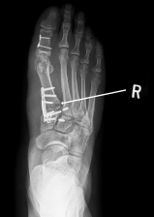
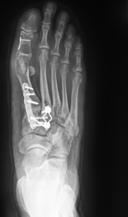
Failed midfoot reconstruction may produce persistent pain, collapse, loss of alignment, broken fixation, nonunion, or malunion.
The revision may require complete correction of the deformity, removal of prior hardware, takedown of the nonunion, restoration of alignment in multiple planes, bone grafting, and a different fixation strategy.
The midfoot patient described at the beginning of this article is an example of what can sometimes be achieved when the cause of failure is identified and a new reconstruction is planned around it.
Revision midfoot fusion
Failed midfoot fusion with malunion and nonunion, followed by revision reconstruction restoring alignment and stability.
Revision hindfoot and ankle fusion
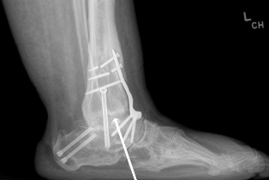
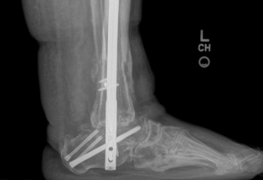
Failed hindfoot or ankle fusion may involve nonunion, malunion, limb-length discrepancy, adjacent-joint disease, infection, painful implants, or persistent deformity.
These operations may require bone-graft strategies, correction of alignment, revision fixation, external fixation, or limb-length restoration. The amount and quality of remaining bone, the soft-tissue envelope, blood supply, and presence or absence of infection all influence the plan.
The goals are individualized, but frequently include less pain, a stable plantigrade foot, improved gait, and the ability to wear regular shoe gear.
Revision hindfoot fusion
Failed hindfoot fusion with persistent deformity or nonunion, followed by complex revision reconstruction.
Revision total ankle replacement and total talus reconstruction
Revision total ankle replacement requires the surgeon to understand both the original implant and the options available when components fail, loosen, subside, become infected, or no longer function within the patient’s alignment and remaining bone stock.
Some cases can be revised to another ankle replacement. Others require fusion, bone reconstruction, custom implants, total talus replacement, or a combination of techniques.
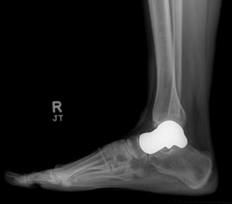
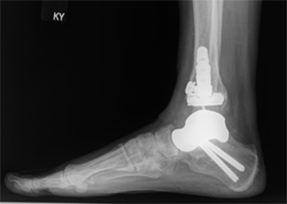
One of my patients[VK2.1] had a failed total talus reconstruction. I ultimately converted her to a combined total talus replacement, total ankle replacement, and subtalar fusion. This was not a matter of repeating the original procedure. It required changing the treatment algorithm and designing the reconstruction around the anatomy and function that remained.
Failed total talus revision
Failed total talus reconstruction converted to a combined total talus replacement, total ankle replacement, and subtalar fusion.
Revision Charcot reconstruction and limb salvage
Revision Charcot surgery is an entirely different undertaking from correcting a recurrent bunion or revising an otherwise healthy midfoot fusion.
The patient’s vascular status, glucose control, nutrition, neuropathy, infection risk, soft tissues, bone quality, wounds, and support system all affect the plan.
Revisional Charcot literature similarly emphasizes the need to account for vascular status, infection control, nutrition, glucose management, and broader medical optimization. [5]
Success may mean a stable limb, healed wounds, eradicated infection, prevention of further collapse, the ability to use a brace or shoe, and avoidance of amputation.
A systematic review of Charcot reconstruction found substantial potential for limb salvage but also a significant complication burden, underscoring the importance of careful patient selection and realistic counseling. [6]
A failed Charcot reconstruction cannot be evaluated by the same standards as a failed primary bunion correction. The anatomy, biology, objectives, and risks are fundamentally different.
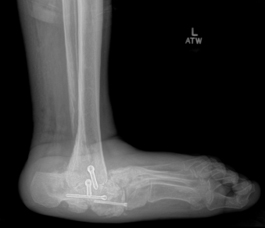
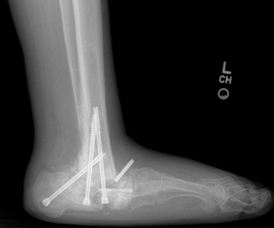
Revision Charcot reconstruction
Revision Charcot reconstruction performed to restore stability, protect the soft tissues, and preserve a functional limb.
How I define success after revision surgery
My principal objectives are:
- Improved pain
- Improved function
- Greater independence
- The ability to wear normal shoe gear when achievable
- A meaningful improvement in quality of life
Revision surgery is not primary surgery. We often need to think in terms of incremental improvement.
Of course, I want complete improvement for every patient. Sometimes that is realistic. A failed bunion reconstruction or midfoot fusion can often be completely corrected.
A failed Charcot reconstruction is a different story. Success may mean controlling infection, healing a wound, maintaining a stable limb, returning to protective shoe gear, or avoiding amputation.
Each case is different. The goal is always the greatest achievable improvement, but the definition of success depends on the pathology, biology, previous operations, and where the patient is starting.
That is why patient-surgeon alignment is requisite before proceeding.
Experience, preparation, and the revision "playbook"
When patients ask what they should look for in a revision surgeon, my answer is straightforward: Experience. Experience. Experience.
The surgeon should be thoroughly versed in the primary operation that was performed. Understanding the original procedure provides the foundation required to recognize why it failed and what can be salvaged, revised, or abandoned.
High-volume revision work also creates a broader toolbox. The surgeon sees recurring patterns of failure and becomes more adept at anticipating the problems that may not be obvious on initial imaging.
When I teach residents, I repeatedly tell them: The time of surgery is to implement, not to decide.
I mentally perform every operation before entering the operating room. That applies to both primary and revision surgery. I have a principal plan and multiple "what if" plans:
- What if the bone stock is worse than expected?
- What if the implant is broken or cannot be removed normally?
- What if the deformity is more severe than the imaging suggests?
- What if the soft tissue will not tolerate the planned exposure?
- What if the cultures suggest infection?
- What if the original plan is no longer technically possible?
Preparation creates options, and options create safety.
There is no textbook chapter titled "revision of everything that has gone wrong." The playbook is written around the patient and the specific failure in front of us.
We still follow central reconstructive principles, but revision surgery requires creativity, experience, judgment, and the surgical acumen to carry out an intervention that may need to change as the operation unfolds.
Revision and complex reconstruction constitute approximately one-third of my practice. I evaluate revision bunion and forefoot cases, revision midfoot reconstruction, failed hindfoot and ankle fusion, revision total ankle replacement, total talus failures, Charcot reconstruction, infection, and limb-salvage problems every week.
I have served as a design surgeon for implants intended for difficult revision and reconstructive applications and have lectured nationally and internationally on complex cases.
I do not share those facts to tell patients that every problem can be fixed. I share them because revision surgery should not be an occasional undertaking for the surgeon performing it.
Advocate first, physician second, surgeon third
A patient who has already endured an unsuccessful operation may reasonably ask: "Why should I trust another surgery?"
That is a valid question.
Most revision problems I evaluate are not immediately life- or limb-threatening. There is usually time to slow down, investigate the problem, consider the options, and decide whether another operation is truly the right choice.
I am never going to be a used-car salesman for surgery.
I tell my patients that my primary role is advocate number one, physician number two, and surgeon number three.
We review the original issue, the prior treatment, the symptoms that remain, and the available nonsurgical and surgical options. We discuss what another surgery might reasonably accomplish and what it cannot promise.
Then the patient decides.
I frequently encourage patients to go home and think or pray about it. I may ask them to return with a spouse, family member, or trusted friend so we can have the conversation again before making a commitment.
My job is not to convince a patient to undergo another surgery. My job is to help the patient determine whether another surgery offers a reasonable path toward a better life.
The support system is part of the reconstruction
A strong support network is integral to success.
Revision recovery may require transportation, help with meals, medication management, assistance with bathing or mobility, wound observation, home preparation, childcare, work planning, and emotional support during an extended period of restricted activity.
I often use humor to make the point that living long enough sometimes means allowing yourself to become a temporary burden on the people who love you.
Accepting help is not weakness. It is part of the treatment plan.
Before proceeding, we need to know not only whether I can perform the reconstruction, but also whether the patient has a realistic way to recover from it.
Traveling to Dallas–Fort Worth for revision care
I regularly evaluate patients traveling from other parts of Texas, other states, and outside the United States.
I am happy to begin with an initial telehealth consultation when appropriate imaging and medical records are available. This allows me to understand the previous intervention, review the current symptoms, identify missing information, and determine whether an in-person evaluation in Dallas–Fort Worth is likely to be useful.
However, telehealth cannot complete the revision assessment.
If we are considering surgical intervention, an in-person physical examination is requisite before I commit a patient to an operation.
Patients seeking an initial remote review should obtain:
- Operative reports
- Relevant clinic notes
- Preoperative imaging
- Postoperative imaging
- Current imaging
- CT or MRI studies when available
- The actual image files as well as the written reports
- Culture results, laboratory studies, or vascular testing when relevant
The more complete the record, the more productive the initial conversation can be.
Thirty-six prior operations did not mean there were no options left
One of my longtime patients had undergone 36 operations before he came to see me.
His problems began with a motor vehicle accident that ultimately left him with bilateral tibial nonunions and malunions. By the time he arrived, his life had been shaped by repeated operations, persistent deformity, and years of dysfunction.
I treated both extremities with external fixation followed by complex reconstruction. The process required three operations on each leg.
He is now approximately eight years out. He is gainfully employed, married, and still comes to see me every year.
His result does not mean that every patient with dozens of prior operations can be restored. It means that a long surgical history does not automatically prove that every reasonable option has been exhausted.
The next plan must be deliberate. It must be individualized. It must account for the patient’s anatomy, biology, emotional resilience, support network, and realistic goals.
But the case may not be hopeless.
You may not have exhausted your options—but do not rush
Some revision patients are so desperate that they arrive wanting to schedule surgery before they have even met me. That is precisely when we need to slow the process down. Patients should be their own strongest advocates. Gather your records. Obtain the actual imaging. Ask questions. Understand the diagnosis. Ask what the alternatives are. Ask what happens if you do nothing. Ask what success realistically means. Ask whether the reconstruction can be performed in one operation or will require multiple stages.
A failed prior surgery does not necessarily mean your case is hopeless. It also does not mean that another surgery is automatically the right answer. There may still be a path forward, but hope should be built on clarity, preparation, experience, and an honest plan.
If a prior foot or ankle surgery has not provided the outcome you expected, you may still have options.
Contact [VK3.1]the Orthopedic Institute of North Texas to schedule a revision evaluation or speak with one of our representatives about the records, imaging, and next steps needed to begin the process.
You do not have to decide on another surgery today.
You only need to take the next informed step.
Frequently Asked Questions
Does a failed foot or ankle surgery mean it was botched?
No. A failed outcome does not automatically mean the procedure was performed negligently. Surgery may fail because of diagnosis, planning, fixation, healing biology, infection, recurrent deformity, patient factors, or an unfavorable outcome despite reasonable care. A revision evaluation should focus objectively on the current problem before assigning blame.
Can revision foot or ankle surgery still work after several prior operations?
In many cases, yes. The number of prior surgeries is only one factor. The remaining anatomy, bone stock, blood supply, soft tissues, presence of infection, medical condition, and objectives of treatment are more important than the number alone. However, each additional operation may increase complexity and risk.
Will revision surgery require more than one operation?
Sometimes. Infection, major bone loss, failed hardware, poor soft-tissue coverage, or complex deformity may require a staged reconstruction. The purpose, timing, recovery, and anticipated outcome of each stage should be discussed before treatment begins.
What imaging is needed for a revision consultation?
The required imaging depends on the problem. Weight-bearing X-rays are frequently the starting point. CT may help assess fusion, bone stock, implant position, and three-dimensional deformity. MRI may be useful for soft tissues, tendon pathology, infection, or other specific concerns. The surgeon should review the actual images rather than relying only on the radiology report.
Can an out-of-town patient begin with telehealth?
Yes, when appropriate records and imaging are available. Telehealth may be used for the initial discussion and record review. An in-person physical examination is still necessary before committing to revision surgery.
Is amputation always necessary after a failed reconstruction or deep infection?
No. Many patients may still have reconstructive or limb-salvage options. However, some severe infections, vascular problems, nonfunctional limbs, or medically dangerous situations may make amputation the safest or most functional option. The recommendation should be individualized after a thorough evaluation.
How long does revision recovery take?
There is no universal recovery timeline. It depends on the procedure, bone healing, soft-tissue condition, infection, weight-bearing restrictions, medical factors, and whether the reconstruction is staged. Recovery is rarely linear, but the overall trajectory should move toward less pain and better function.
Research references
- Factors Associated With Nonunion and Infection Following Ankle Arthrodesis Using a Large Claims Database: Who Has Elevated Risk?. Open source
- Complex Regional Pain Syndrome: A Narrative Review for the Practising Clinician. Open source
- Unsuspected Low-Grade Infection in Revision Surgery for Nonunion in Foot and Ankle Arthrodesis. Open source
- Revision Surgery for Failed Hallux Valgus Correction: A Systematic Review. Open source
- Revisional Charcot Foot and Ankle Surgery. Open source
- Charcot Foot Reconstruction Outcomes: A Systematic Review. Open source

Justin Kane, M.D.
Foot & Ankle Orthopedic Surgeon
Dr. Justin M. Kane is a board-certified, fellowship-trained orthopedic surgeon specializing in foot and ankle surgery at the Orthopedic Institute of North Texas, serving patients across the Dallas–Fort Worth area.
With more than a decade of experience and thousands of procedures performed, Dr. Kane has developed particular expertise in minimally invasive bunion surgery and advanced reconstructive techniques for complex foot and ankle conditions, including deformity, trauma, arthritis, limb salvage and limb lengthening.
He is known for his patient-centered approach, combining surgical precision with individualized treatment planning to help patients preserve motion, restore function, and return to an active lifestyle with confidence.