
PRP is promising for some foot and ankle problems, disappointing for others, and too often marketed as though those differences do not exist.PRP is promising for some foot and ankle problems, disappointing for others, and too often marketed as though those differences do not exist.
Platelet-rich plasma-or PRP-is one of those treatments where the marketing has gotten considerably ahead of the medicine.
Depending on what you read online, PRP can supposedly regenerate cartilage, heal tendons, eliminate arthritis, prevent surgery and cure practically anything that hurts. I wish it were that simple.
I am interested in orthobiologics. I think they have a role in orthopedic care. I also think that role needs to be defined by the diagnosis, the patient and the evidence-not by the fact that somebody owns a centrifuge.
When patients come to see me from Frisco, North Dallas, Plano, Prosper, McKinney and the surrounding North Texas communities asking about PRP for heel pain, Achilles problems, ankle arthritis[VK2.1] or cartilage injuries, my first question is not, "Can we inject PRP into this?" Of course we can. The more important question is: "Does PRP actually make sense for the problem you have?"
The treatment should follow the diagnosis-not the marketing.
What exactly is PRP?
PRP stands for platelet-rich plasma. A patient's own blood is drawn and processed-usually through centrifugation-to separate and concentrate a platelet-containing portion of the blood. That preparation is then injected into a specific area of injury or degeneration.
Platelets do more than participate in clotting. They carry signaling proteins and growth factors involved in inflammation, tissue repair and healing. That provides a biologically plausible rationale for using concentrated platelets around selected injured tissues. PRP is an orthobiologic treatment; it is not a stem-cell injection.
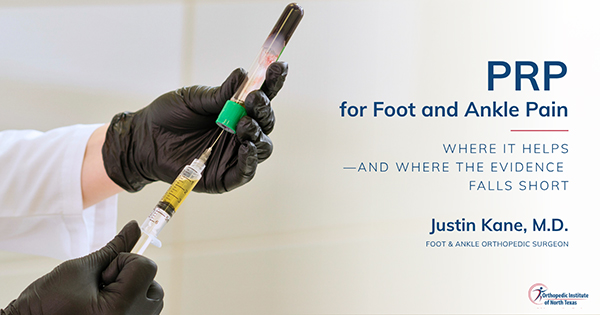
 PRP begins with the patient’s own blood, which is processed to create a platelet-concentrated preparation.
PRP is not one standardized product
This is one of the most important limitations in the PRP literature. Different commercial systems and preparation techniques can produce meaningfully different concentrations of platelets, leukocytes and red blood cells. Studies may use different centrifugation protocols, injection volumes, activation techniques, number of injections and rehabilitation plans-yet all of them may simply be called "PRP."
Reporting has also been inconsistent. In a systematic review of PRP studies for osteochondral lesions of the talus[VK3.1], the average adherence to the MIBO reporting checklist was only 42.8%, and no included study reported at least half of the checklist items. That makes reproducibility and apples-to-apples comparison difficult. [1]
So when someone tells you, "The studies prove PRP works," my response is: for what diagnosis, which PRP formulation, how was it prepared, how many injections were given, and compared with what? Those details matter.
The evidence at a glance
| Condition | What current evidence suggests | My practical take |
|---|---|---|
| Chronic plantar fasciitis | Multiple randomized trials and meta-analyses show better intermediate-term pain and function than corticosteroid in selected patients. | One of the more reasonable PRP discussions in foot and ankle care. |
| Achilles tendinopathy | Recent placebo-controlled meta-analysis found no significant clinical or imaging benefit. | I do not present routine PRP as a proven Achilles treatment. |
| Ankle osteoarthritis | High-quality randomized trial found no advantage over saline at 26 weeks; 52-week follow-up remained negative. | Not established as a disease-modifying treatment for ankle arthritis. |
| Talar cartilage injury / OLT | Promising evidence, especially as an adjunct to bone-marrow stimulation or other reparative surgery. | Interesting and potentially useful, but not a universal stand-alone injection. |
| Lateral ankle ligament injuries | Current systematic reviews show limited, heterogeneous and inconsistent evidence. | Not routine; case selection and evidence limitations matter. |
Where PRP has some of the strongest lower-extremity evidence: chronic plantar fasciitis
Among the lower-extremity problems I treat, chronic plantar fasciitis-or, more accurately in many long-standing cases, plantar fasciopathy-has one of the more supportive bodies of evidence for PRP.
That does not mean every patient with heel pain needs an injection. Most do not. The diagnosis has to be correct first. Heel pain can come from the plantar fascia, a nerve, the calcaneus, the Achilles complex, the heel fat pad or another problem. Putting PRP into the wrong diagnosis simply gives you an expensive injection into the wrong problem.
A 2025 meta-analysis of 24 randomized controlled trials involving 1,653 participants found that PRP produced better pain scores than corticosteroid at three and six months, and better AOFAS functional scores at three, six and twelve months. At one month, however, outcomes were not significantly different-an important reminder that PRP is not typically an instant-gratification treatment. [2]
A separate meta-analysis of 21 randomized trials and 1,356 patients also found advantages for PRP across several pain and function outcomes, although results varied by measure and comparison treatment. [3]
For an appropriately selected patient with chronic plantar fascia symptoms that have failed a structured conservative program, I think PRP is a legitimate option to discuss.
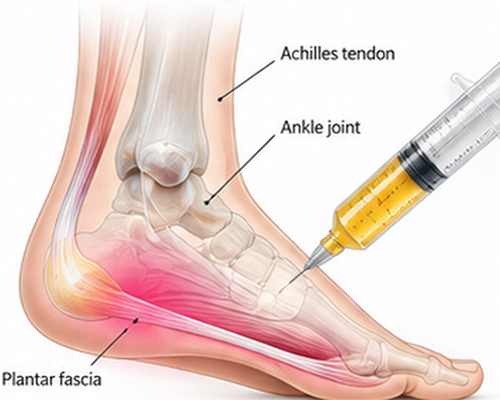 PRP is not one treatment for one body part. The diagnosis and target tissue determine whether an orthobiologic strategy is even reasonable.
Achilles tendinopathy: biologically appealing, clinically disappointing so far
Achilles tendinopathy[VK4.1] seems like exactly the sort of problem PRP should treat: chronic degenerative tendon, impaired healing biology, and a treatment containing platelet-derived signaling molecules. It is an appealing biological story.
Unfortunately, appealing biology and clinical efficacy are not the same thing. A recent meta-analysis of randomized placebo-controlled trials included 337 patients and found no significant improvement in Achilles-specific function, pain, tendon thickness or vascularity with PRP compared with placebo at the principal follow-up intervals. [4]
That does not prove no future PRP formulation or patient subgroup will ever benefit. It means I am not comfortable telling a patient that PRP is a proven treatment for chronic Achilles tendinopathy today.
This distinction becomes even more important for insertional Achilles disease, where bone morphology and mechanical impingement may be major pain generators. Biology cannot remove a Haglund prominence or correct a structural mechanical problem.
Ankle arthritis: do not borrow the knee literature
PRP is frequently discussed for knee arthritis. That has led many patients to assume that the same evidence automatically applies to the ankle. It does not. A tibiotalar joint is not a knee, and we should not transplant evidence from one joint into another simply because the syringe is the same.
A multicenter randomized, double-blind, placebo-controlled trial of 100 patients compared two ultrasound-guided intra-articular PRP injections with saline placebo for ankle osteoarthritis. At 26 weeks, the change in symptoms and function was not significantly different between groups. Follow-up through 52 weeks also failed to demonstrate a meaningful PRP advantage. [5]
Individual patients can still report improvement after an ankle PRP injection. An individual response, however, is different from evidence that a treatment reliably outperforms placebo across a population.
PRP does not regrow a destroyed ankle joint. It does not correct deformity. It does not restore missing cartilage simply because we want it to.
Cartilage injuries of the talus may be a more interesting application
An osteochondral lesion of the talus is different from generalized end-stage ankle arthritis. These are focal cartilage and underlying bone injuries, often related to trauma. Here, PRP becomes more interesting-particularly as an adjunct to a reparative procedure rather than as a magical stand-alone injection.
A 2025 systematic review included 35 studies, eight of them clinical human studies. Among studies that evaluated PRP as an adjunct to bone-marrow stimulation, four of five reported significant improvements in pain or function compared with bone-marrow stimulation alone. The authors still emphasized variability in PRP preparation and the limited number of high-quality comparative trials. [6]
A network meta-analysis of six randomized trials likewise found that PRP-assisted microfracture performed favorably among studied adjunctive therapies for talar osteochondral lesions. [7]
My interpretation is deliberately restrained: promising, plausible, and worth studying-not definitive.
Ankle sprains, ligament injuries and other tendons: the data thin out quickly
As we move into lateral ankle ligament injuries, peroneal tendon disease, posterior tibial tendon pathology and other less-studied indications, the evidence becomes increasingly sparse and heterogeneous. A 2026 systematic review of PRP for lateral ankle ligament injuries identified only five comparative studies and found no consistent short-term advantage over controls. [8]
A different 2025 review of acute ankle sprains suggested possible short-term pain relief and earlier return to activity, but the limited pooled data showed comparable later functional outcomes. That is exactly the kind of signal that should generate better trials-not broad marketing claims. [9]
PRP does not fix mechanics
This may be the most important point in the entire discussion: biology cannot reliably outrun bad mechanics.
If a patient has a major deformity, an unstable joint, displaced tendon, substantial nonunion, end-stage arthritis, infection or another structural problem, injecting PRP does not make the underlying mechanical problem disappear.
If the plantar fascia is chronically degenerative and the mechanics are manageable, a biological treatment may make sense. If there is substantial insertional Achilles pathology with a large bony impingement problem, an injection does not remove the bone. If an ankle has collapsed into end-stage post-traumatic arthritis, PRP does not rebuild the joint.
There is a tendency in regenerative medicine to focus on what is inside the syringe. As an orthopedic surgeon, I am much more interested in why the tissue became symptomatic in the first place.
PRP is not completely benign
Because PRP comes from a patient's own blood, it is sometimes described as though there is essentially no downside. That is not quite accurate.
A 2025 systematic review of randomized foot and ankle trials found that treatment-site pain occurred more often after PRP than after comparison injections. Serious complications were uncommon, but "autologous" does not mean "risk free." The risks and expected post-injection course should still be discussed before treatment. [10]
Who is the patient I actually want to consider for PRP?
I do not want someone coming into my office having already decided they need PRP. I want someone coming in because they have a lower-extremity problem they want solved.
First, establish the diagnosis. Then understand what has already been attempted. Then determine whether there is an underlying mechanical problem that needs to be corrected. Then look at the available evidence for that particular pathology.
If PRP occupies a rational place between appropriate conservative treatment and surgery, we can have that conversation. If the literature is poor and there is a better-supported option, I am going to tell the patient that too.
I have no interest in selling somebody an expensive syringe simply because they would rather hear the word "regenerative" than discuss the actual pathology.
What happens during a PRP injection?
The process itself is relatively straightforward. Blood is drawn from the patient and placed into a processing system that separates a platelet-concentrated plasma fraction. That preparation is then delivered to the intended treatment site. Depending on the anatomy and pathology, image guidance may be appropriate to improve placement accuracy.
The rehabilitation protocol should be based on what is being treated-not on a generic PRP recipe. A plantar fascia is not an Achilles tendon. A tendon is not an ankle joint. An osteochondral lesion is not generalized arthritis.
Why some patients improve even when the science is uncertain
Medicine is rarely black and white. Patients improve after treatments for many reasons. Sometimes the treatment genuinely works. Sometimes the natural history of the condition improves. Sometimes the rehabilitation performed alongside the intervention is responsible for much of the change. Sometimes symptoms regress toward the mean because patients tend to seek care when they are at their worst. And sometimes there is a placebo effect.
The placebo effect is not imaginary. It is a real biological and psychological phenomenon that can meaningfully influence how symptoms are experienced. That is precisely why randomized placebo-controlled trials matter.
A testimonial can tell us what happened to one person. A properly designed clinical trial helps determine whether the treatment itself was responsible. Both can be valuable, but they answer different questions.
My approach to PRP in Frisco, North Dallas and North Texas
My approach is deliberately simple: I am not trying to find patients for PRP. I am trying to determine whether PRP is appropriate for the patient in front of me.
There are conditions-particularly chronic plantar fasciopathy-where I think there is enough evidence to have a serious discussion about PRP after appropriate conservative treatment has failed. There are emerging indications, such as augmentation of selected talar cartilage procedures, that I find scientifically interesting and potentially valuable.
There are other conditions, including chronic Achilles tendinopathy and ankle arthritis, where contemporary randomized evidence should substantially temper our enthusiasm.
That is how new technology should enter medicine: not because it sounds innovative, not because patients are asking for it, and certainly not because it can be sold as a cash-pay service. It should earn its place.
The better question is not "Do you offer PRP?"
The better question is: "Is PRP the right treatment for me?" Sometimes my answer may be yes. Sometimes it will be maybe. Sometimes it will be no. I think patients deserve all three answers.
If foot or ankle pain is limiting your activity and you are considering PRP, the first step should not be scheduling an injection. It should be establishing the diagnosis and understanding all of your options.
Frequently Asked Questions About PRP for Foot and Ankle Conditions
- What is PRP?
Platelet-rich plasma is prepared from a patient's own blood. The blood is processed to create a platelet-concentrated plasma fraction, which is then injected into a targeted area. It is an orthobiologic treatment, but it is not a stem-cell injection. - What foot and ankle condition has the best evidence for PRP?
Among common foot and ankle conditions, chronic plantar fasciitis has one of the more supportive evidence bases. Recent randomized-trial meta-analyses suggest better intermediate-term pain and function than corticosteroid injection in selected patients. - Does PRP work for plantar fasciitis?
It can be a reasonable option for appropriately selected patients with chronic plantar fasciitis after a structured conservative program has failed. The benefit, when present, is usually not immediate; differences in clinical trials tend to emerge over the following months. - Is PRP better than a cortisone injection?
That depends on the diagnosis. In chronic plantar fasciitis, several contemporary analyses favor PRP over corticosteroid at intermediate follow-up. That does not mean PRP is universally superior to corticosteroid for every orthopedic condition. - Does PRP work for Achilles tendinopathy?
Current high-quality evidence is not convincing. Recent placebo-controlled meta-analysis has not shown a meaningful improvement in pain, function or imaging outcomes for chronic Achilles tendinopathy. I therefore do not present PRP as a proven Achilles treatment. - Does PRP help ankle arthritis?
The best randomized ankle-arthritis trial found no significant improvement from PRP compared with saline placebo, including at longer-term follow-up. Knee arthritis data should not automatically be extrapolated to the ankle. - Can PRP help an osteochondral lesion or cartilage injury of the talus?
Possibly. The evidence is promising, particularly when PRP is used as an adjunct to procedures such as bone-marrow stimulation. The evidence is less established for PRP as a stand-alone cure for a focal cartilage lesion. - How many PRP injections do I need?
There is no evidence-based universal number. Studies use different PRP formulations and dosing schedules. I would be skeptical of any predetermined "package" of injections offered before the diagnosis and treatment goals are established. - Is PRP painful or risky?
Temporary post-injection pain is relatively common. Serious complications appear uncommon, but PRP is not completely risk-free simply because it comes from the patient's own blood. The risks and expected recovery depend on the location being treated. - Can PRP prevent me from needing surgery?
Sometimes a nonsurgical treatment-including PRP for selected indications-may improve symptoms enough that surgery is unnecessary or can be deferred. But PRP cannot reliably correct major deformity, instability, infection, end-stage arthritis or another structural problem. The goal is to choose the least invasive treatment with a reasonable probability of solving the actual diagnosis.
References
- Butler JJ, et al. Poor adherence rates to the Minimum Information for Studies Evaluating Biologics in Orthopaedics (MIBO) guidelines for clinical studies on platelet-rich plasma for osteochondral lesions of the talus. Foot Ankle Surg. 2025;31(4):291-298. PMID 39580252. PubMed / source
- Zuo A, et al. Platelet-Rich Plasma Versus Corticosteroids in the Treatment of Plantar Fasciitis: A Systematic Review and Meta-analysis. Am J Phys Med Rehabil. 2025;104(7):613-621. PMID 39778212. PubMed / source
- Herber A, et al. Platelet rich plasma therapy versus other modalities for treatment of plantar fasciitis: A systematic review and meta-analysis. Foot Ankle Surg. 2024. PMID 38395675. PubMed / source
- Platelet-rich plasma vs placebo injections in Achilles tendinopathy: systematic review and meta-analysis of randomized controlled trials. PMID 41997478. PubMed / source
- Paget LDA, et al. Effect of Platelet-Rich Plasma Injections vs Placebo on Ankle Symptoms and Function in Patients With Ankle Osteoarthritis: A Randomized Clinical Trial. JAMA. 2021. PubMed / source
- Halayqeh S, et al. The Role of Platelet-Rich Plasma in Treating Osteochondral Lesions of the Talus: A Systematic Review of Clinical and Preclinical Evidence. JBJS Rev. 2025;13(12). PMID 41379984. PubMed / source
- The optimal adjunctive therapies for microfracture treatment of osteochondral lesions of the talus: a systematic review and network meta-analysis of randomized controlled trials. PMID 40241089. PubMed / source
- Platelet-Rich Plasma for Lateral Ankle Ligament Injuries: A Systematic Review of Current Evidence and Limitations. PMID 42333922. PubMed / source
- Banerjee S, et al. Efficacy of Autologous Platelet-Rich Plasma for the Treatment of Ankle Sprain: A Systematic Review of Literature with Limited Meta-Analysis. 2025. PMID 40657216. PubMed / source
- Platelet-Rich Plasma Injections for Foot and Ankle Pathologies Have Significantly More Complications Compared With Hyaluronic Acid Injections, Saline Solution Injections, and Dry Needling: A Systematic Review. Arthroscopy. 2025;41(10):4357-4366. PMID 40209826. PubMed / source

Justin Kane, M.D.
Foot & Ankle Orthopedic Surgeon
Dr. Justin M. Kane is a board-certified, fellowship-trained orthopedic surgeon specializing in foot and ankle surgery at the Orthopedic Institute of North Texas, serving patients across the Dallas–Fort Worth area.
With more than a decade of experience and thousands of procedures performed, Dr. Kane has developed particular expertise in minimally invasive bunion surgery and advanced reconstructive techniques for complex foot and ankle conditions, including deformity, trauma, arthritis, limb salvage and limb lengthening.
He is known for his patient-centered approach, combining surgical precision with individualized treatment planning to help patients preserve motion, restore function, and return to an active lifestyle with confidence.